Sometimes I want Bode plots with frequency in Hz rather than rad/s, or a magnitude in absolute units rather than dB. I've been using workarounds like calling bode with output arguments and plotting it myself, or frequency-shifting the transfer function (for frequency in Hz).
But it turns out you can change it! Call ltiview, and you can use the GUI to change the default axis settings (File -> Toolbox Preferences).
Thursday, February 17, 2011

Wednesday, February 2, 2011
Sonar project kickoff
A new project! The goal is to develop an ultrasonic ranger that uses the Doppler effect to produce instantaneous velocity estimates. If successful, I also want to look into a two-receiver setup using interaural time and level differences to produce map the echoes into 3 dimensions.
I've been kicking the idea around in my head for a while, and started working in earnest on hardware January 4.
I've been kicking the idea around in my head for a while, and started working in earnest on hardware January 4.
New plants!
Got these new plants a few weeks ago. A cactus (Red-headed Irishman):
 A small, cute plant that I can't remember the name of (this is why I need to post things sooner rather than later). It's probably some sort of sedum?
 We planted it in this large pot with our avocado tree. In the pot is also a String of Buttons and a Pachyveria Powder Puff ("Exotica"), as well as a rock.


Tuesday, February 1, 2011

I Love Blue Sea
A while back, we got a Groupon for i love blue sea, a San Francisco (they also ship nationwide) seafood distributor that provides incredibly fresh (sushi quality) sustainable seafood at good prices (definitely cheaper than the local supermarket for comparable items).
Over the weekend, we placed an order and drove up to the city to pick it up (their warehouse is open for pickups from 12-1pm, Monday - Saturday). They filled our little cooler and with ice and seafood. With the pickup discount, we got:

 That's lightly seared tuna on top, because we had a ton of it. Per pound, it's a great price, but the 1.5 lb minimum order puts us into a region of diminishing returns.
 It's not actually green; that's unfortunately how fluorescent light comes out on film. Anyways, we made a lot of tuna-and-avocado rolls with the winter-ripening bacon avocado we'd gotten from the farmer's market by Moss Landing. It was awesome.

Over the weekend, we placed an order and drove up to the city to pick it up (their warehouse is open for pickups from 12-1pm, Monday - Saturday). They filled our little cooler and with ice and seafood. With the pickup discount, we got:
- 1 dozen Hood Canal Bay oysters ($16)
- 1.5 lb Hawaiian pole-and-line albacore tuna ($20)
- 1 lb Prince Edward Island mussels ($6)
The oysters were amazing. Difficult to open (we both ended up stabbing ourselves with a 3" paring knife), but delicious.

It turns out we were storing them a bit colder than optimal (ideal is 35-40 °F, with adequate oxygen supply), but we ate them over the course of 36 hours without ill effect.
At only $6, I think the mussels were best deal of all. We ate a few raw (I don't recommend it - they're kinda bitter) and boiled the rest to make a sauce for linguine (olive oil, white wine, mussels, bell pepper, tomato). All the mussels were alive, and there was enough for 2 plates like this:


We then had seared tuna for lunch the next day. The searing adds a welcome complexity of taste to the surface, while the bulk maintains the texture of the raw fish. We want the surface temperature to reach 150°C for the Maillard reaction, but want to minimize the region that exceeds 60°C (turns opaque and flaky). So if raw albacore tuna has a thermal diffusivity of 0.15 mm2/s and we start at an initial condition of 0°C, this is starting to sound like a parabolic PDE...
The boundary condition is problematic. Making it isothermal with the pan defeats the purpose of our modeling; perhaps constant heat flux is more appropriate. Furthermore, the meat's heat capacity becomes ∞ for a while when it reaches 100°C, but we can approximate this effect by adding fMΔHvap/CP to the goal temperature, where fM is the tuna's moisture content (63%), ΔHvap is water's heat of vaporization (2257 J/g), and CP is the specific heat of tuna (3.1 J/g K). This gives us a target surface temp of 610°C...
Okay, looks like ΔHvap is a bigger player than I initially thought. Within the fish, conduction would be best modeled with an isothermal boundary condition at 100°C. Using the semi-infinite slab solutions (which is actually just an ODE after nondimensionalization), we get T(x,t) = Tsurfaceerfc(x/√4αt). We're interested in when/where T = 60°C, i.e. x/√4αt = erfc-1(60/100) = 0.37. For x in mm and t in s, this comes out to x = 0.29√t. So that ~1 mm "cooked" layer in the picture would have taken 12 sec.
The next question is to find how long it takes for the fish surface to reach 150°C. Unfortunately this requires more information, including the heat flux into the surface and some sort of diffusion length for the movement of moisture from the bulk into the rapidly-dehydrating surface. These are the primary factors in determining how long it will take to brown the surface.
As a side note, I have got to figure out how to put LaTeX into blog posts; formatting formulae in HTML is terribly unwieldy.
Anyways, we still had leftover fish after the seared tuna lunch, so we've salted the rest in much the same way as we did before.
The boundary condition is problematic. Making it isothermal with the pan defeats the purpose of our modeling; perhaps constant heat flux is more appropriate. Furthermore, the meat's heat capacity becomes ∞ for a while when it reaches 100°C, but we can approximate this effect by adding fMΔHvap/CP to the goal temperature, where fM is the tuna's moisture content (63%), ΔHvap is water's heat of vaporization (2257 J/g), and CP is the specific heat of tuna (3.1 J/g K). This gives us a target surface temp of 610°C...
Okay, looks like ΔHvap is a bigger player than I initially thought. Within the fish, conduction would be best modeled with an isothermal boundary condition at 100°C. Using the semi-infinite slab solutions (which is actually just an ODE after nondimensionalization), we get T(x,t) = Tsurfaceerfc(x/√4αt). We're interested in when/where T = 60°C, i.e. x/√4αt = erfc-1(60/100) = 0.37. For x in mm and t in s, this comes out to x = 0.29√t. So that ~1 mm "cooked" layer in the picture would have taken 12 sec.
The next question is to find how long it takes for the fish surface to reach 150°C. Unfortunately this requires more information, including the heat flux into the surface and some sort of diffusion length for the movement of moisture from the bulk into the rapidly-dehydrating surface. These are the primary factors in determining how long it will take to brown the surface.
As a side note, I have got to figure out how to put LaTeX into blog posts; formatting formulae in HTML is terribly unwieldy.
Anyways, we still had leftover fish after the seared tuna lunch, so we've salted the rest in much the same way as we did before.
Monday, January 24, 2011
More French bread iterations
I've given my French bread recipe a couple more tests now, and I have some more thoughts:
- Moisture is the most critical parameter. When it's wet, it's very elastic and sticks to everything. It doesn't shape very well, but still rises nicely. The crumb is nice and open, but the bread is still denser than I'd like. Maybe I need to bake it longer to drive out the extra moisture? When it's less wet, it's easier to work with, but sometimes the crumb comes out very dense. I think all this indicates that I have poor control of moisture, and that the ideal level is somewhere between the extremes I've tried.
- The knob on our oven temperature control has a ton of backlash, so I don't have good temperature control. Baking temperatures are +/- 25 deg F, maybe more.
- Fairly sensitive to salt. Once I accidentally put in a whole teaspoon of salt (the ink has rubbed off all our plastic spoon measures), and that was far too salty. At 1/2 teaspoon, you can taste the salt in the bread. At 1/4, it's just right. Haven't tried it without salt.
- 1/2 C whole wheat flour is a bit much. I went down to 1/4 C for a while, and am now doing about 1/8 C (2 T). I like the taste better with less whole wheat.
Thursday, January 20, 2011
Fridge settings
A few weeks ago, I turned the fridge temperature control knob from 3 to 4 (with 1 being the warmest and 5 being the coldest). Dunno what the impact is on power consumption (the outlet is inaccessible without moving the fridge), but there's been a marked reduction in food spoilage!
Tuesday, January 11, 2011
Hawaii - day 8
Saturday, Dec 18: We went to the Waikiki Aquarium and Honolulu Zoo.
I'm actually writing this in May, but dating it for January to keep the posts together. So I don't have much to say, just pictures/videos to share.
 Outdoors tank at Waikiki Aquarium. We talked to one of the volunteers there. He says the fish are really easy to keep - they're all from reefs around the area and they just cycle in water from the ocean. Apparently there's a bird that comes and eats some fish every week. But so far it's just been the one bird, so they just let him be.
They also had Hawaiian monk seals, which are an endangered species:
They're trained to touch their noses to the stick that the trainer is holding. It's pretty funny...once one sees it within reach, he very eagerly galumphs over and sticks his nose to it.
Probably not visible in the video is the green algae growing on the seal's face. We're told the algae eventually covers their entire body over the course of a year and is only removed when they molt.
Inside the aquarium, they have a huge giant clam:
 They grow them from smaller giant clams:
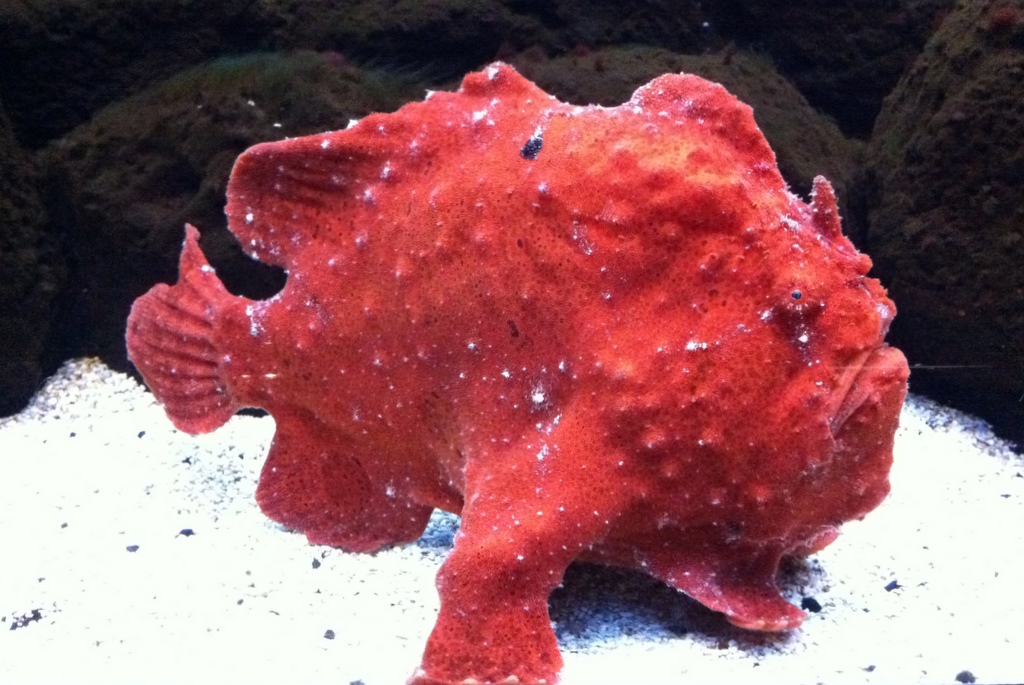
 There was also this fish:
 What.
What.
Outside, I saw a lizard. I'd never seen wild lizards before this trip, so my first impression was that it must be a plastic lizard toy someone had dropped...
 We walked across Kapiolani park, which is beautiful...
 ...to the Honolulu Zoo.
They had lots of tropical birds, which was pretty awesome. There was a bower bird, but it wasn't doing anything interesting. Lots of birds of paradise and parrots:
There was also an open area with a pond for flamingos and many wild birds just visiting for the food. Pretty awesome.
Also an aviary, which is awesome:
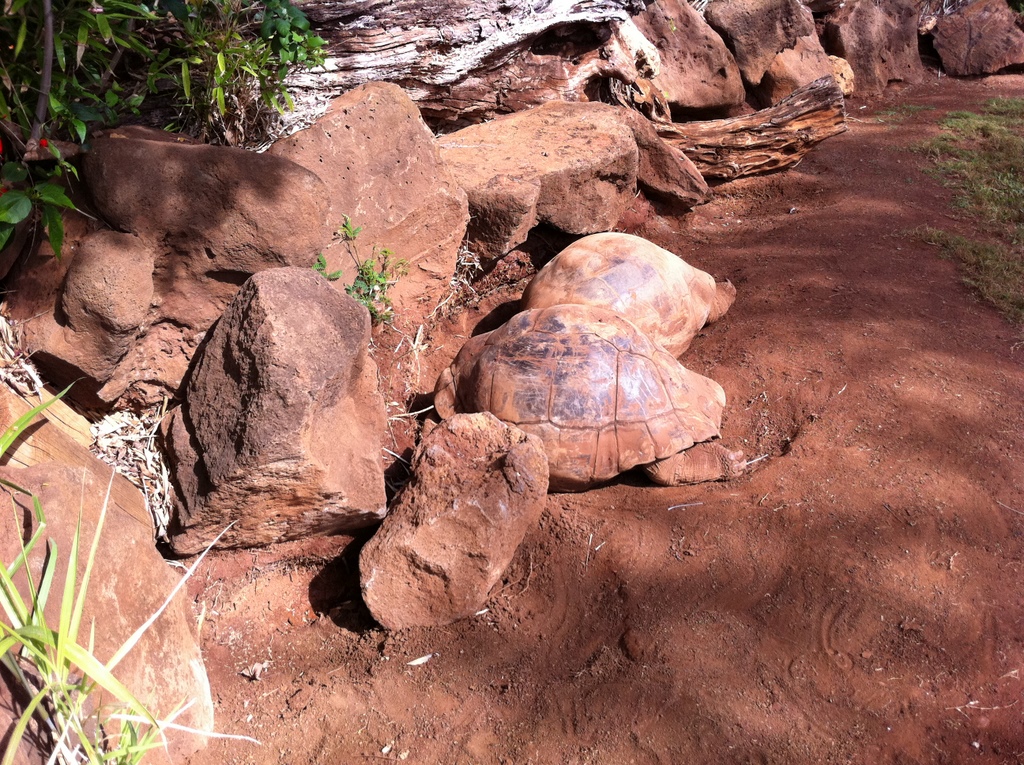
And tortoises!
 And a monkey of some sort showing off awesome acrobatics:
There were also other animals. Not as interesting, though...same as you'd see in any other zoo. This was interesting:
 Also, the cutest fox:
 And a peacock looking expectantly at diners in the food court:
 And the highly endangered Nene goose, endemic to Hawaii.

After the zoo, we visited 'Iolani palace. A giant banyan tree next to a parking lot! What!
 Also, what! I guess this is Christmas in Hawaii...
 And that was it for our Hawaii trip. One final item of note at the Honolulu airport:
 Because macadamia nuts are a Hawaiian specialty, and Spam is a Hawaiian specialty, so naturally...Spam-flavored macadamia nuts!
I'm actually writing this in May, but dating it for January to keep the posts together. So I don't have much to say, just pictures/videos to share.

They also had Hawaiian monk seals, which are an endangered species:
They're trained to touch their noses to the stick that the trainer is holding. It's pretty funny...once one sees it within reach, he very eagerly galumphs over and sticks his nose to it.
Probably not visible in the video is the green algae growing on the seal's face. We're told the algae eventually covers their entire body over the course of a year and is only removed when they molt.
Inside the aquarium, they have a huge giant clam:


Outside, I saw a lizard. I'd never seen wild lizards before this trip, so my first impression was that it must be a plastic lizard toy someone had dropped...


They had lots of tropical birds, which was pretty awesome. There was a bower bird, but it wasn't doing anything interesting. Lots of birds of paradise and parrots:
There was also an open area with a pond for flamingos and many wild birds just visiting for the food. Pretty awesome.
Also an aviary, which is awesome:
And tortoises!
There were also other animals. Not as interesting, though...same as you'd see in any other zoo. This was interesting:


After the zoo, we visited 'Iolani palace. A giant banyan tree next to a parking lot! What!


Monday, January 10, 2011
Hawaii - day 7
Friday, Dec 17: We make spam and eggs for breakfast.
First stop of the day is Lyon Arboretum.
 It's a simulated tropical rain forest (the climate is real; the species are introduced from all over the world). This one is a walking tree, native to central and south America.
 And I have no idea what the rest of these plants are!


 This one (below) is covered in ants! Perhaps it is pollinated by them?
 The arboretum contains a network of trails, some of which are quite bushy and hard to navigate. There's also a ton of mosquitoes and it was quite hot. Most of us were pretty miserable, so we didn't stray much from the main trail. It ends at Aihalualama Falls, which is not terribly exciting:

 One of the buildings (probably a tool shed) was starting to grow epiphytes of its own:

After Lyon Arboretum, we walked down to the Manoa Falls trailhead. It's supposed to be an easier hike than the arboretum, and it started off with a wide, flat trail.
 Right after I took this picture of the mushrooms, a young child came by. His father pointed out the mushrooms, the kid took note of them, and then proceeded to completely forget about their existence as he took a step forward (stepping squarely on the mushrooms) to get a closer look at something else that captured his attention. What.
Anyways, trees! The rain forest exhibit in the California Academy of Sciences does not do justice to these giant canopy trees.

 We were particularly impressed by the space-filling efficiency of these trees.

After a short while, the trail started getting narrower, steeper, and harder to walk on.
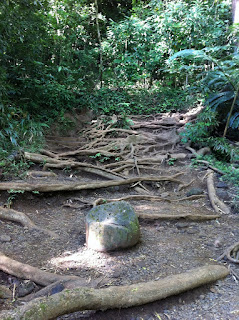 At one point, were were walking on parallel planks of wood elevated a few inches off the ground. But still we persevered and ultimately got to the falls.


And that was that. The trail was pretty quiet; not a lot of people. There were these two runners that passed us twice (they wore bells to warn others of their arrival; the constant jangling must be terribly annoying) and maybe 10 small groups like us.
We were pretty tired after that, and started driving up to Oahu's North Shore. We stopped at a McDonald's in Wahiawa (saw lots of military personnel; maybe there's a base nearby?) and SC and I got food at the L&L Drive Inn next door.
 We had a BBQ mixed plate and a lau lau plate. $16, but enough for 3 people and pretty good! Both plates came with macaroni salad; I guess it's a thing.
Afterwards, we continued on Kamehameha Highway (99) and stopped briefly at Dole Plantation to see if we could find any pineapples on sticks:
 We wandered through the small pineapple varietal garden until we could accept the sight of pineapples springing out of the ground on stalks. Otherwise, we were thoroughly uninterested by the prospect of the World's Largest Maze, rather uncomfortable about the celebration of plantation life, and amused by this mass of koi:

We continued heading north along Kamehameha Highway...

... and stopped at Laniakea, a beach known for its sea turtles.
 The surf (and/or volcanic origins?) had created a very interesting texture to the rocks at the water's edge.
 There were lots of snails! A lot of them in dried-up dimples:
 I imagine they used a simple gradient descent method and ended up stuck in these local minima isolated from the larger pools of water. As a population, though, this ends up as a sort of shotgun approach (like random-restart hill climbing), which can be pretty efficient. It just ends up poorly for some individuals.
Anyways, the water was clear and pretty...
 ... and the sea turtles were there, as promised, with an adoring crowd.
 Volunteers put up red rope around the turtles and yell at anybody who ends up on the wrong side. They've also identified most of the turtles and will tell you about those individuals if you ask.
 The turtles themselves seemed pretty content just to sit in one place and bask in the sun. I suppose this red rope crowd control method wouldn't work if they weren't so sedentary on land. Mouseover for the names given by the volunteers.

![]()
I also found these rocks interesting: the algae makes them look like moss-covered rocks on a riverbank, but they're in the ocean!

After Laniakea, we continued along Kamehamea Highway into Pupukea. We at Pupukea Beach Park. It was almost sunset, which gave the rocks a warm glow:
 We hung around the tide pools and saw lots of fish (including some very small ones that didn't photograph well). Again, used this site for identifications.


After that, we continued north on Kamehamea Highway just a little bit further and made our final stop at 'Ehukai Beach Park, site of the 2010 Billabong Pipe Masters competition. There wasn't anything competition-related at the time, but there were still some surfers out there. We're told the waves today weren't particularly big, but this is the time of year with the biggest waves.

First stop of the day is Lyon Arboretum.


On the way back we saw the White-rumped Shama I posted about earlier. We also heard (and saw, but it was too far away for a decent photo) a wild cockatoo. He was just sitting high up in a canopy tree, screeching his head off. Incredibly loud, and it sound carries quite well.
Back at the parking lot, we saw a pickup truck with some interesting flowers stacked in the bed:
Back at the parking lot, we saw a pickup truck with some interesting flowers stacked in the bed:


After Lyon Arboretum, we walked down to the Manoa Falls trailhead. It's supposed to be an easier hike than the arboretum, and it started off with a wide, flat trail.

Anyways, trees! The rain forest exhibit in the California Academy of Sciences does not do justice to these giant canopy trees.


After a short while, the trail started getting narrower, steeper, and harder to walk on.


And that was that. The trail was pretty quiet; not a lot of people. There were these two runners that passed us twice (they wore bells to warn others of their arrival; the constant jangling must be terribly annoying) and maybe 10 small groups like us.
We were pretty tired after that, and started driving up to Oahu's North Shore. We stopped at a McDonald's in Wahiawa (saw lots of military personnel; maybe there's a base nearby?) and SC and I got food at the L&L Drive Inn next door.

Afterwards, we continued on Kamehameha Highway (99) and stopped briefly at Dole Plantation to see if we could find any pineapples on sticks:


We continued heading north along Kamehameha Highway...

... and stopped at Laniakea, a beach known for its sea turtles.


Anyways, the water was clear and pretty...


I also found these rocks interesting: the algae makes them look like moss-covered rocks on a riverbank, but they're in the ocean!

After Laniakea, we continued along Kamehamea Highway into Pupukea. We at Pupukea Beach Park. It was almost sunset, which gave the rocks a warm glow:


After that, we continued north on Kamehamea Highway just a little bit further and made our final stop at 'Ehukai Beach Park, site of the 2010 Billabong Pipe Masters competition. There wasn't anything competition-related at the time, but there were still some surfers out there. We're told the waves today weren't particularly big, but this is the time of year with the biggest waves.

Subscribe to:
Posts (Atom)